Keeping an edge between carving sessions
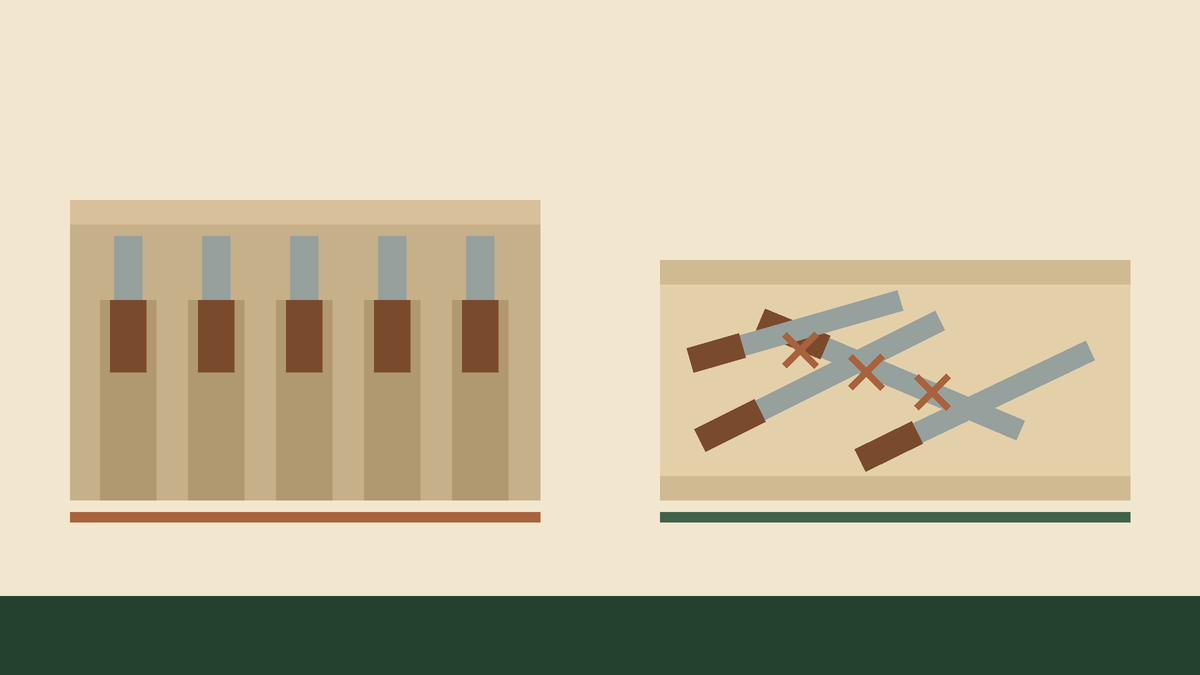
Ask a carver why their knife stopped cutting well and they will describe the last thing they carved. Usually the answer is somewhere else entirely: the tool spent three weeks loose in a drawer next to a steel rule, or on a windowsill through a damp autumn, and the edge was gone before it ever touched wood again.
The three things that dull a stored edge
- Contact with other metal. A carbon steel edge is harder than the steel around it but far thinner, and one slide against a rule or another blade takes a visible nick out of it.
- Moisture. Carbon steel tools rust readily, and the first place rust appears is the thin steel at the edge, where it does the most damage per gram.
- Compression against a hard surface. Standing a gouge on its edge in a jar, or letting a knife rest edge-down on a bench, flattens the apex over time.
Storage that actually works
The traditional answer is a tool roll: a strip of canvas or leather with a sewn pocket per tool, rolled and tied. Each edge is separated from every other by two layers of fabric, and the roll holds tools by their handles rather than their edges.
A block with drilled holes does the same job for a fixed bench, provided the holes are deep enough that no edge touches wood. For a small collection, the cheapest working solution is a piece of cardboard tube slit down one side and slipped over each blade — free, and better than a shared drawer.
Leather sheaths, with a warning
Vegetable-tanned leather is mildly acidic and holds moisture against steel. A blade left in a tight leather sheath for months can come out with rust exactly where the leather touched.
Sheaths are for carrying, not for storing. If a tool is going away for a season, take the sheath off.
Managing humidity
The practical threshold is around sixty per cent relative humidity: above that, bare carbon steel starts to spot within weeks. Most homes sit below it most of the year, which is why the problem shows up seasonally rather than constantly.
Two low-effort measures cover almost every case. Wipe the blade with a lightly oiled cloth before putting it away — camellia oil is traditional, mineral oil works, and a food-safe oil is sensible for anything that touches spoons. And keep tools away from exterior walls and windows, which are where condensation happens first.
If you live somewhere consistently humid, a sealed box with a reusable desiccant pack is more reliable than any oil, and needs recharging in an oven every few months rather than any daily attention.
Rust that has already appeared
Light surface spotting comes off with a nylon abrasive pad and a little oil, followed by a normal stropping. It is cosmetic and the tool is unharmed.
Pitting is different. Once corrosion has eaten into the steel at the edge, sharpening past the pits means removing metal until the edge sits behind the deepest one, which on a badly pitted gouge can be a millimetre or more. That is a stone job and a slow one, and it is the reason the wiping habit is worth building.
A closing routine
Thirty seconds at the end of a session: strop each tool that was used, wipe each blade with the oiled cloth, put every tool back into its own pocket. Done every time, it removes almost all of the maintenance that otherwise accumulates into an afternoon at the stones.