Chip carving: cutting your first clean triangle
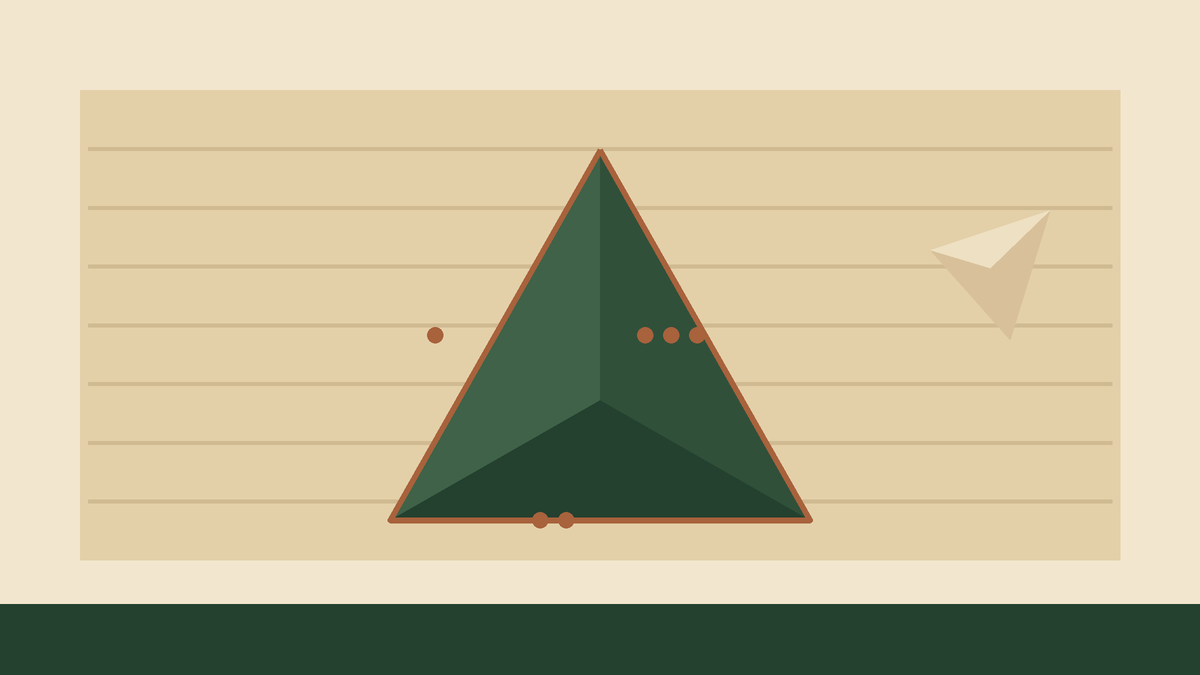
Chip carving looks like a pattern discipline and it is really a geometry one. Every design in the tradition — the rosettes, the borders, the wheat ears cut into Swiss and Bavarian boxes — is built from one shape, a three-sided pyramid removed from the surface. Learn to cut that shape cleanly and the patterns become a question of layout rather than skill.
The geometry, before the knife
Draw an equilateral triangle about 15 mm on a side. Mark its centre. The chip you are going to remove is a pyramid with that triangle as its base at the surface and its apex directly below the centre mark, roughly 4 mm down.
Every cut you make is one wall of that pyramid, angled from a side of the triangle down to the apex. Three walls, three cuts, one chip. If all three planes meet exactly at the apex, the chip releases with a small dry click and leaves three clean facets. If they miss each other, the chip tears out and the bottom looks ragged.
The knife and the grip
Chip carving uses a short blade with a straight edge and a squared-off point, held quite differently from a whittling knife. The handle sits in the palm, the thumb rests flat on the wood beside the work as a pivot, and the first knuckle of the index finger rides on the surface to fix the depth.
That contact is what makes chip carving repeatable. Depth is not judged by eye each time; it is set by the geometry of the hand against the board, so every cut in a border comes out the same.
The three cuts, in order
- Set the blade along the first side of the triangle, leaning the handle over so the edge angles in toward the centre at roughly sixty degrees from the surface. Push down and along the line in one motion, deepest at the middle of the side and shallow at each corner.
- Rotate the board — not your hand — and repeat along the second side, aiming the plane at the same apex point.
- Cut the third side the same way. On the last stroke the chip loosens. It should lift out on the blade tip without being levered.
If the chip will not come out
Two planes probably met above the apex, leaving a wedge of uncut fibre at the bottom. Re-cut the shallowest wall slightly deeper rather than prying, which crushes the edges of the triangle and cannot be undone.
Never lever a stuck chip with the blade tip. Chip knives are ground thin and the tip is the first thing to break.
Grain direction inside a triangle
One of the three sides will always run against the fibre, because the triangle sits at three different angles to the grain. That side is the one that tears, and the fix is to cut it first, while the wood around it is still fully supported, and to take it in two lighter passes rather than one.
Basswood tolerates this better than any other species, which is why it dominates chip carving. Butternut and jelutong also behave well. Anything with pronounced growth rings will fight you at every third cut.
Practising the row
Rule two parallel lines 15 mm apart across a board and fill the strip with triangles, alternating point up and point down. It is the standard exercise and it exposes everything at once: consistency of depth, whether your apexes are landing in the same place, and whether the walls are actually flat rather than slightly dished.
A row of thirty triangles takes about an hour and teaches more than any single decorative piece. When the facets in a row all catch the light identically, the technique is there, and the traditional patterns are just arrangements of what you can already do.